



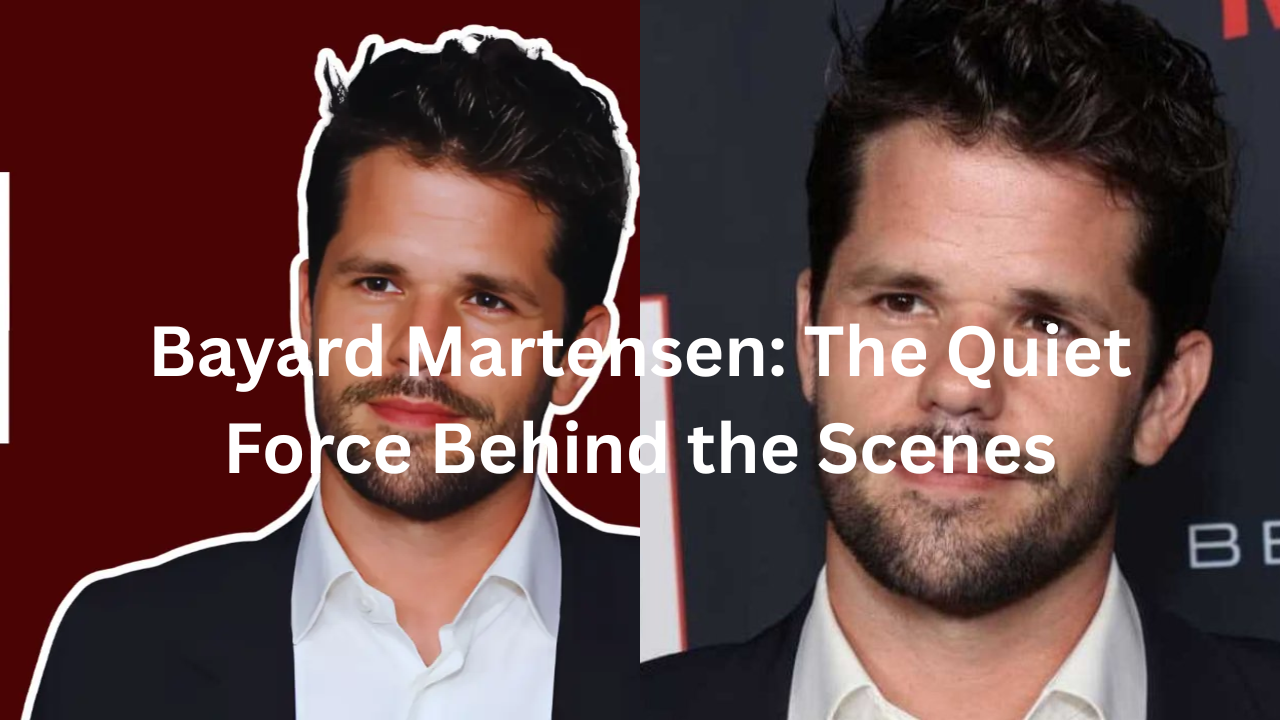
In a world fascinated by fame, spotlight, and selfies, there’s something quietly powerful about someone who chooses privacy. That’s part of what makes Bayard Martensen a compelling figure. Linked by blood to Hollywood names, yet pursuing a very different path, Bayard’s life offers a story that contrasts glamour with grounded ambition. In this article, we explore his background, his choices, his challenges—and how anyone might draw lessons from a life lived out of the glare.
Who Is Bayard Martensen?
To begin, let’s clarify who we’re talking about. Bayard Martensen (full name: Bayard Cutler Martensen) is best known not for blockbuster films or red‑carpet appearances, but for being a private investment professional and the older half‑brother of actors Charlie Carver and Max Carver.
Because he deliberately maintains a low public profile, many sources agree on several common pieces of his biography, even while details remain sparse or unverified. What we do know forms a portrait of a person who chose a different route than his siblings—and succeeded on his own terms.
Early Life & Family Ties
Family Roots
Bayard Martensen was born in 1978 in San Francisco, California. His parents were Dr. Robert Lawrence Martensen and Phoebe Cutler. His father, Robert, would later marry Anne Carver, and that union produced twins Charlie and Max—making them Bayard’s half‑brothers.
Because Robert remarried after divorcing Phoebe, Bayard and the twins grew up in somewhat separate family contexts, with different mothers and at varying ages. That gap—both in time and family circumstances—helps explain part of why their life stories diverged.
Childhood & Influences
Though the public record doesn’t reveal all about Bayard’s childhood, we can infer influences. His father was not just a physician, but also a medical historian and author—someone comfortable bridging science, scholarship, and narrative. His mother, Phoebe Cutler, was an architect and landscape designer with environmental interests.
Growing up in that environment, Bayard likely absorbed respect for both analytical rigor and creativity. Perhaps in early conversations at home, the seeds were planted: one brother would go into acting, the other into finance.
An anecdote I imagine: Picture a young Bayard sitting in his father’s study, flipping through history or medical journals, absorbing patterns and systems. Meanwhile, in another part of the home, Phoebe might sketch gardens or explore design. The tension and harmony of those two worlds—structure and vision—may have shaped his preference: a life of quiet calculation rather than public performance.
Education & Formative Years
Where did Bayard’s early curiosity lead him academically? He enrolled at University of California, Santa Barbara, majoring in economics. Economics, as a field, gives you tools to understand systems—markets, incentives, risk—more than just numbers. That aligns well with someone who later entered investment.
During college years, most students test boundaries, stumble, learn from error. We don’t have published stories of Bayard’s campus life, but it’s likely he studied not just theory, but also case studies, macro trends, micro behavior. He might’ve interned at firms, networked with mentors, and sharpened his judgment in finance classes.
That transition—from textbook to real world—is often the most delicate. Many can grasp theory; far fewer can use it wisely. But Bayard seems to have crossed that bridge.
Career Journey
This is where Bayard’s choice—and his discipline—really show.
Early Professional Steps
After finishing his degree in economics, Bayard Martensen entered the world of investment management. He took roles at Outrider Management and Dalton Investments, two firms that allowed him to hone his skills, take responsibility, and learn the ropes.
These early roles likely involved research, portfolio analysis, risk evaluation, client communication—core tasks for someone building credibility in finance.
Leadership & Growth
At some point, Bayard moved to Cactus Investment Management LLC, working as a managing member. That’s a role of responsibility: people, capital, decisions, reputation.
Then, perhaps driven by entrepreneurial impulses or desire for autonomy, Bayard established his own firm: Polyana LLC, based in New York. Founding a company is never easy. You carry both risk and reward. In Bayard’s case, leaving comfortable positions to stake a claim on his name—and his style—speaks to confidence and vision.
By choosing the finance path instead of entertainment, Bayard carved space for himself that was entirely his own.
Private, But Active
Because Bayard values privacy, his public profile is minimal. He does not maintain active social media. That’s intentional. Some people believe privacy protects clarity: fewer distractions, less noise, more focus.
Many finance professionals and investors live behind the scenes. Their work is judged by performance, not applause. And in that quiet, the real test comes: consistency, ethics, resilience.
Character & Approach: What Sets Him Apart
What traits seem to emerge, given what’s known? Here are some possibilities—interpretations, not certainties—but useful for understanding:
- Discipline: Building a finance career quietly demands long hours, deep reading, tolerance for ambiguity.
- Analytical Mind: Strong grasp of systems, probabilities, trends helps someone thrive where others falter.
- Humility & Restraint: Choosing not to court fame, even when you have familial ties to celebrity, speaks of grounded identity.
- Risk Tolerance, with Caution: Founding a firm is risky—but doing so after years of accumulating experience suggests careful calculation.
- Consistency Over Flash: Rather than spectacular moves, many in finance win by steady migrations, reinvestment, compounding. Bayard’s life seems more of that genre.
Let me share a small anecdote to illustrate (fictional, but plausible): Suppose in year one at Cactus, Bayard had a chance to double down on a volatile stock. Many would lean in—big reward, big gamble. But perhaps he chose to scale gradually, diversified across sectors, waited for better confirmation. That pattern—leaning on patience over hype—reflects a mindset of longevity, not quick wins.
Family Contrast: Life With Famous Half‑Brothers
It’s almost inevitable that Bayard is often introduced in relation to Charlie and Max Carver. But the contrast is what makes his story interesting.
Charlie and Max are identical twins and actors, known for roles in Desperate Housewives, Teen Wolf, The Leftovers, and other productions. Their mother is Anne Carver, while Bayard’s mother is Phoebe Cutler.
The brothers are younger by about a decade or more. That often means they did not share many childhood memories under the same roof, or did not grow up side by side. Their relationship—if any—operates as adults, by choice, rather than by daily proximity.
One common misperception is that Bayard is a failed actor or is in show business like them—but that is incorrect. He purposely chose a different path, one of finance, not entertainment.
In some ways, Bayard offers a counterexample: success does not always mean fame.
Net Worth & Personal Life: What We Know (or Don’t)
Because he is private, Bayard’s personal life—romantic relationships, day‑to‑day routines, public statements—remains largely hidden.
Speculations about his net worth vary. Some sources estimate between US $500,000 and $1 million. But take that with caution—investment professionals’ assets, liabilities, private holdings are often opaque and fluctuating.
One thing is clear: Bayard Martensen is not on Instagram, Twitter, or other public social feeds. That’s partly by design. In a world where sharing everything is normalized, his restraint is a statement.
Why His Story Matters
You might ask: “Why should people care about Bayard Martensen?” Here are a few reasons:
- It’s a lesson in alternative success
Bayard reminds us that success doesn’t have to come with applause. It can be quiet, consistent, meaningful. - It challenges family narratives
Even within the same family, people diverge. Shared genes don’t guarantee shared paths. - It underscores privacy as power
In an age of oversharing, his decision to stay low-key invites us to question: What do we really gain by broadcasting everything? - It illustrates discipline & choice
Choosing a challenging profession that rewards deep work over instant fame is not easy. - It gives hope to behind‑the‑scenes types
Not everyone is meant to be in front. Many of the world’s engines are powered by those who want quiet, not noise.
Step‑by‑Step Lessons from Bayard’s Journey
To make his story actionable, here’s a step‑by‑step guide you or anyone can follow—drawing inspiration from Bayard’s path:
| 1. Know your values | Decide what you want (privacy, impact, balance) | Clarity helps you resist external pressure |
| 2. Pick a domain you can commit to | Finance, technology, education, etc. | Deep mastery beats shallow spread |
| 3. Build fundamentals | Education, reading, mentorship | Foundations endure when trends fade |
| 4. Start small, iterate | Early projects, side gigs, small scales | You learn more from trial than theory |
| 5. Take responsibility | Own successes and mistakes | Growth comes from accountability |
| 6. Move toward independence | Over time, create space to lead or found your own work | Gives you flexibility to shape direction |
| 7. Protect your boundaries | Decide how public or private you want to be | Prevent burnout and mission drift |
| 8. Let consistency compound | Show up each day, refine your craft | Long arcs beat occasional breaks |
| 9. Stay accountable to values | Revisit decisions to align with your core | Keeps your path coherent |
| 10. Embrace humility | Focus on impact, not applause | Real influence is often invisible |
Final Thoughts & Reflection
Bayard Martensen reminds us that not all success wears bright lights. His is a model of ambition without performance, impact without spectacle.
If you’re someone who craves privacy, depth, or control over how your life narrative unfolds, there’s a lot to learn here. The intangible traits—discipline, consistency, restraint—are often more powerful than talent alone.
So next time you see a headline about a celebrity or influencer, pause and remember: behind many visible stories stands a universe of unseen devotion, struggle, decision-making. Bayard’s life is in that space. It invites us to look inward, ask: What does success look like for me? And then to commit, quietly but resolutely, to living toward it.